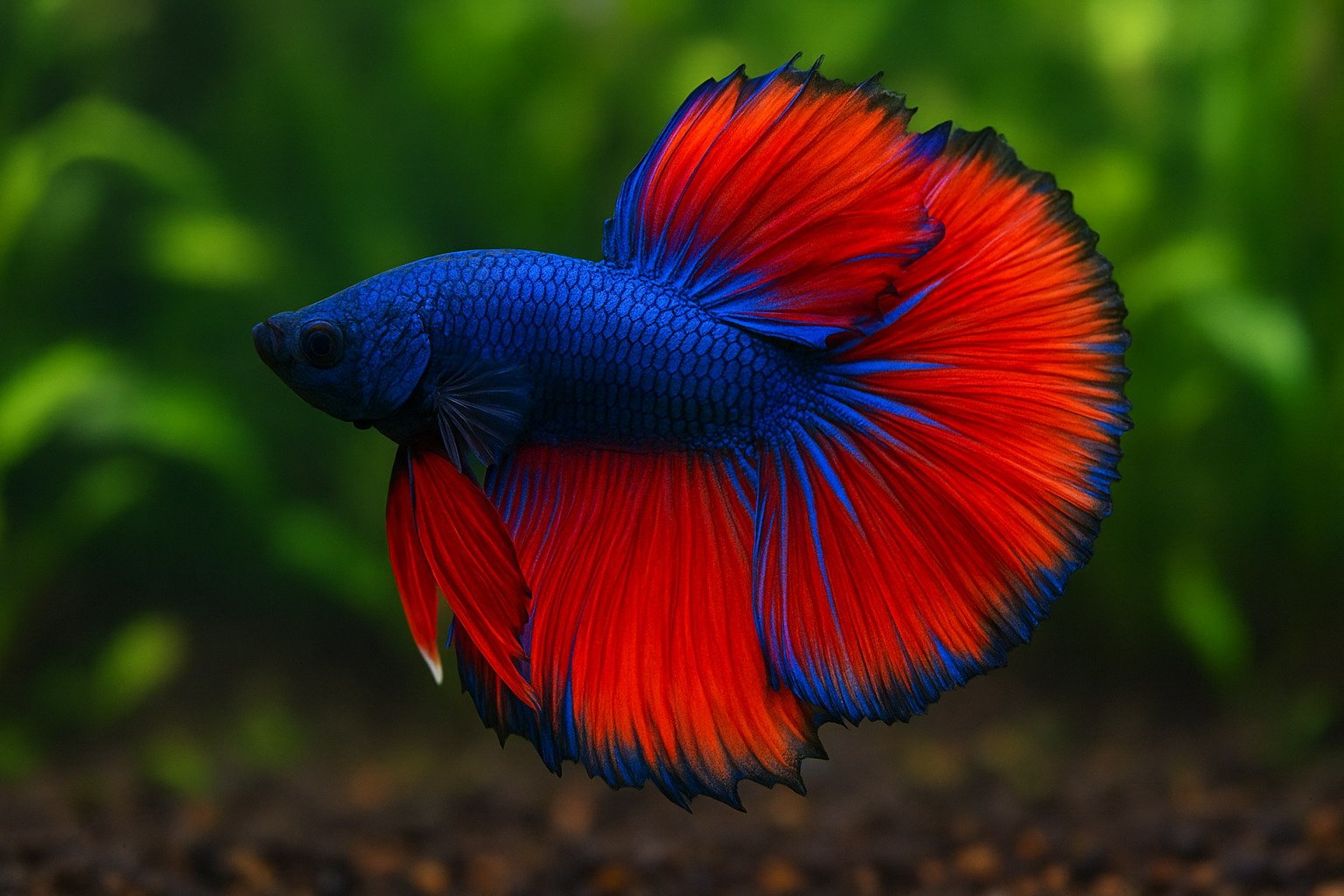
The halfmoon double tail male betta fish is one of the most visually striking and highly sought-after varieties among aquarium enthusiasts. Known for its 180-degree tail spread and uniquely split caudal fin, this fish is a combination of elegance and intensity. Its vibrant colors, flaring displays, and symmetrical double tail create a showpiece effect in any aquarium.
This guide dives deep into everything you need to know—from genetics and history to care, breeding, and health. Whether you’re an experienced betta keeper or just discovering this variety, this article will help you understand what makes the halfmoon double tail male betta fish exceptional and how to properly care for it.
A quote from a seasoned betta breeder sums it up perfectly:
“A well-bred halfmoon double tail male betta is like living art—perfect symmetry, dramatic flair, and personality in every flick of the fin.”
In This Article
Origins and History of the Halfmoon Double Tail Male Betta Fish
The double tail trait (known genetically as dt) has been selectively bred from wild betta splendens for many decades. Initially considered a genetic anomaly, breeders soon recognized its potential to produce larger dorsal fins and broader tail structures.
The halfmoon tail shape, defined by its full 180° flare, was later paired with the double tail gene through years of strategic crossbreeding. This resulted in today’s highly refined halfmoon double tail male betta fish, also known as HDT or HM-DT among professionals.
Historical Timeline
| Year/Period | Milestone |
| Early 1900s | Betta splendens introduced to captive breeding |
| 1960s | Double tail gene first noticed in selective breeding |
| 1980s | Halfmoon tail form established in show competitions |
| 2000s | Combined double tail + halfmoon variety emerges |
| Today | Considered premium specimen in betta competitions |
Interesting Fact:
Double tail genetics are recessive, meaning both parents must carry the gene to produce true double tail fry. Even then, only around 25–30% of fry will develop the perfect double tail form.
Halfmoon Double Tail Male Betta Fish Genetics
Genetically, the double tail trait influences both tail structure and dorsal fin spread. While it enhances symmetry and display potential, it also increases the risk of deformities such as overly short bodies or spinal curvature.
Key Genetic Facts
- The double tail trait is recessive (dt/dt).
- Crossbreeding single tail (st/st) with double tail often produces carriers (st/dt), not visually double tail.
- Perfect show-quality HM-DT males usually come from specialized breeders carefully pairing compatible fin and body structures.
Pros & Cons of Double Tail Genetics
| Advantages | Challenges |
| Larger tail span | Prone to swim bladder issues |
| Enhanced dorsal fin | Higher risk of spinal deformity |
| Better display symmetry | Requires careful breeding selection |
| Ideal for competitions | Sensitive to strong water flow |
Case Study – Breeding Outcome Insight
A breeder in Thailand paired a halfmoon single tail female with a double tail male. Out of 150 fry:
- 30 became true halfmoon double tail males
- 40 displayed partial double tail expression
- 80 showed standard halfmoon single tail
This demonstrates why selective pairing is crucial to reproduce top-tier halfmoon double tail male bettas.
Physical Characteristics of Halfmoon Double Tail Male Betta Fish
The halfmoon double tail male betta fish is prized for its dramatic appearance. The hallmark of this variety is the 180-degree tail spread combined with a perfectly split caudal fin, known as the double tail. Unlike standard halfmoon bettas, the double tail gene creates two distinct lobes at the base of the tail, giving the fish an exceptional display when flared.
Key Physical Features
- Tail shape: Full 180° halfmoon spread, split vertically into two lobes.
- Body symmetry: Shorter body structure often more compact than single-tail bettas.
- Fins: Enlarged dorsal fin and well-framed anal fin.
- Colors: Common color patterns include blue, red, white, turquoise, koi, butterfly, galaxy, mustard gas, and metallic. Recently, nemo galaxy halfmoon double tail males have become highly popular.
Visual Comparison Table
| Feature | Halfmoon Single Tail | Halfmoon Double Tail Male |
| Tail Spread | 180° | 180° |
| Tail Structure | Single lobe | Dual lobe |
| Dorsal Size | Standard | Larger than average |
| Body Length | Longer | Slightly shorter |
| Swim Flexibility | High | Moderate (care required) |
Did you know?
High-quality halfmoon double tail males often have smoother fin edges compared to single-tail varieties due to even distribution of fin weight.
Behavioral Traits of Halfmoon Double Tail Male Betta Fish
Although visually delicate, halfmoon double tail male betta fish tend to be confident and expressive. Their flaring behavior is both a display of dominance and a natural exercise to strengthen their fins.
Behavior Summary
- Temperament: Generally aggressive toward other males.
- Flare Displays: Often flares at mirrors, reflections, or other fish.
- Swimming Style: Graceful but slower due to the larger fin load.
- Interaction with Owner: Very responsive, especially during feeding or training.
Example Behavioral Observations
| Behavior | What It Means | Recommended Action |
| Constant flaring | High energy or feeling threatened | Limit mirror exposure |
| Lying near filter | Current too strong | Reduce flow |
| Tail biting | Stress, boredom, or tail weight discomfort | Improve tank enrichment |
| Hovering at surface | Low oxygen or water temperature | Check water parameters |
Quote from a hobbyist:
“My halfmoon double tail male betta flares for his reflection like he’s presenting at a fish fashion show.”
Tip: Training short flaring sessions (2–3 minutes twice a day with a small mirror) helps improve tail spread and posture while preventing exhaustion.
Ideal Tank Setup for Halfmoon Double Tail Male Betta Fish
Because of their large fins and sensitivity to current, halfmoon double tail male betta fish require an aquarium setup tailored to their unique needs.
Recommended Tank Specifications
| Tank Element | Ideal Setup |
| Minimum Size | 10 gallons (larger preferred) |
| Filter | Gentle flow sponge or baffled filter |
| Heater | 25W–50W adjustable |
| Temperature | 26–28°C (79–82°F) |
| Lighting | Soft LED, avoid harsh glare |
| Plants | Live plants preferred (Anubias, Java fern, floating plants) |
Environment Guidelines
- Use smooth décor and silk or live plants to prevent fin tears.
- Avoid sharp rocks, plastic plants, and strong filtration.
- Low-flow water system is essential to prevent muscle strain.
- Add leaf litter or Indian almond leaf for natural water enhancement.
Suggested Tankmate Compatibility
| Tank Mate | Compatible? | Notes |
| Snails | ✔ | Ideal, low aggression |
| Shrimp | ✔/✖ | Ok if betta is calm |
| Non-fin nipping small fish | ✔ | Small rasboras or Corydoras |
| Long fin species | ✖ | Could trigger aggression |
| Other male bettas | ✖ | Never recommended |
Quick Tip:
Use a leaf hammock or betta log near the water surface to support resting and reduce fin fatigue.
Best Water Parameters for Halfmoon Double Tail Male Betta Fish
Maintaining stable and optimal water conditions is essential for the health and longevity of a halfmoon double tail male betta fish. This variety is more delicate than standard bettas due to its genetic structure and extensive fin span, which makes it prone to stress and infection when parameters fluctuate.
Ideal Water Conditions
| Parameter | Ideal Range | Notes |
| Temperature | 26–28°C (79–82°F) | Stability is crucial |
| pH Level | 6.5 – 7.2 | Slightly acidic to neutral |
| Water Hardness (dGH) | 4 – 8 | Soft to moderately soft |
| Ammonia (NH3) | 0 ppm | Even slight increases are dangerous |
| Nitrite (NO2) | 0 ppm | Toxic if detectable |
| Nitrate (NO3) | <20 ppm | Maintain low via water changes |
Maintenance Routine
- 20–25% water change every 5–7 days.
- Use RO water mixed with mineral solution if local water is too hard.
- Condition water with dechlorinator before adding to the tank.
- Install a digital thermometer and reliable heater for consistency.
Expert Tip:
“Halfmoon double tail bettas thrive in stable, clean water with minimal current. Fluctuation is more harmful than slightly imperfect parameters.”
Diet and Feeding Guide for Halfmoon Double Tail Male Betta Fish
A nutrition-rich feeding plan significantly influences fin development, coloration, and vitality of the halfmoon double tail male betta fish. As carnivores by nature, they require high-protein foods.
Recommended Foods
- Live Food: Daphnia, brine shrimp, mosquito larvae (best for conditioning before breeding).
- Frozen Food: Bloodworms, blackworms, tubifex.
- High-Quality Pellets: Floating micro-pellets designed for bettas.
- Occasional Treats: Freeze-dried bloodworms (soak before feeding).
Feeding Schedule
| Time | Food Type | Notes |
| Morning | Pellets | 2–3 pieces |
| Evening | Live/frozen food | Small pinch |
| Weekly | Fasting day | 1 day/week to aid digestion |
Dietary Tips
- Avoid overfeeding – full stomach = fin damage from bottom rest.
- Use garlic extract occasionally to boost immunity.
- Add spirulina-based treats for extra pigmentation.
⚠ Avoid foods high in plant filler or using goldfish flakes.
“When feeding halfmoon double tail male bettas, quality beats quantity. Two well-timed, nutrient-dense meals daily work better than frequent small feedings.”
Caring for Fin Health in Halfmoon Double Tail Male Betta Fish
The vast fin structure of halfmoon double tail male betta fish means fin health must be closely monitored. These delicate tails are susceptible to fin rot, tears, stress fraying, and tail biting.
Common Causes of Fin Issues
- Strong water flow
- Unbalanced diet
- Sharp décor
- Tankmate aggression
- High nitrate levels
Prevention & Treatment Table
| Issue | Signs | Solution |
| Fin Rot | Blackened or tattered edges | Salt bath + improve water change routine |
| Tail Biting | Self-inflicted tears | Increase tank enrichment + add mirror exercise |
| Torn Fins | Jagged tears | Remove sharp items + use catappa leaves |
| Stress Fraying | Gradual thinning | Optimize temperature + provide hiding spots |
Fin Recovery Booster Tips
- Add Indian almond leaf (catappa leaf) to create tannin-rich healing water.
- Use low-flow filter foam covers to protect fins.
- Provide rest platforms near the surface to reduce energy loss during swimming.
Special Case Study:
A hobbyist noticed his male halfmoon double tail repeatedly resting on the bottom. Analysis showed strong filter flow was dragging his tail weight downward. After switching to a sponge filter and adding floating plants, full tail recovery occurred within 3 weeks.
Common Health Issues in Halfmoon Double Tail Male Betta Fish
Due to their enlarged fins and unique genetic structure, halfmoon double tail male betta fish are more susceptible to health challenges than other betta types. Understanding these issues early helps prevent complications.
Most Frequently Observed Conditions
| Condition | Symptoms | Causes | Recommended Action |
| Swim Bladder Disorder | Tilting, difficulty swimming | Overfeeding, genetics | Fast 24h + feed daphnia |
| Fin Rot | Tail edge discoloration | Poor water quality | Antibiotics + water change |
| Tail Biting | Self-inflicted tail tears | Stress, boredom | Enrichment + mirror training |
| Velvet Disease | Gold dust-like appearance | Parasite | Dim lighting + copper treatment |
| Constipation | Lethargy, bloating | Poor diet | Fast + pea (crushed) or brine shrimp |
Expert Advice
“Most fin damage starts with stress. Keep current low, maintain near-perfect water, and stimulate mental engagement to promote strong tail health.”
Early Warning Signs Checklist
- 🟡 Reduced appetite
- 🟡 Disinterest in flaring
- 🟡 Dragging tail when swimming
- 🟡 Frequent surface gasping
If two or more symptoms appear, begin observation and corrective action immediately.
Breeding Halfmoon Double Tail Male Betta Fish Successfully
Breeding halfmoon double tail male betta fish requires careful planning due to genetic sensitivity. Only pair fully mature, strong-finned specimens with balanced body proportions.
Ideal Breeding Pair Characteristics
- Male: 8–12 months old, vibrant fins, active flaring.
- Female: 6–10 months old, symmetrical body, preferably single tail to reduce deformity risk.
- Both fish must be healthy, parasite-free, and conditioned with high-protein foods for at least two weeks.
Step-by-Step Breeding Setup
- Conditioning (2–3 weeks): Feed live/frozen foods.
- Spawning Tank Setup:
- 10 gallons minimum
- 5 inches water depth
- Indian almond leaf
- Floating bubble nest platform
- 10 gallons minimum
- Introduce female in chimney or divider
- Release once male builds nest
- After spawning, remove the female
- Remove male when fry are free-swimming (~3–4 days)
Breeding Risk Assessment
| Outcome | Probability |
| High-quality halfmoon double tail fry | 20–30% |
| Single-tail with strong dorsal | 60–70% |
| Deformed body/spine | 5–10% (higher with improper selection) |
Tip: Avoid pairing double tail × double tail as it increases deformities dramatically.
Grooming and Enhancing Display of Halfmoon Double Tail Male Betta Fish
Show-quality halfmoon double tail male betta fish undergo systematic grooming to improve fin spread, posture, and display behavior. Even if not used for competition, this grooming helps keep fins strong and reduces tail biting.
Display Grooming Techniques
- Mirror Training
2–3 minutes twice daily to encourage full tail spreading. - Controlled Light Exposure
Use soft LED lighting; too strong can drain pigmentation. - Color Enhancement Diets
Include astaxanthin and spirulina-enriched foods. - Avoid Strong Currents
Weak current allows proper controlled movement and reduces fin drag.
Ideal Display Tank Features
| Tank Feature | Recommendation |
| Background | Black or dark tone |
| Substrate | Dark sand or smooth gravel |
| Lighting | Soft, angled |
| Plants | Floating, broad-leaved |
| Training Tools | Mini mirror, leaf hammock |
Pro Conditioning Formula
“Rotate between live daphnia, bloodworms, and high-grade pellets. Use mirror training and maintain warm water. These three steps can transform any halfmoon double tail male betta from hobby level to showcase quality.”
Choosing Quality Halfmoon Double Tail Male Betta Fish from Breeders
Selecting a premium halfmoon double tail male betta fish starts with understanding the visual and genetic markers of quality. Look beyond just color and fin spread—symmetry, strength, and posture matter just as much.
What to Look For When Buying
| Feature | Ideal Characteristics |
| Tail Symmetry | Even split, smooth edges, full 180° flare |
| Body Shape | Slightly elongated, no curve in spine |
| Movement | Smooth, controlled, minimal tail dragging |
| Coloration | Strong pigmentation, no fading or discoloration |
| Activity | Responsive, alert, reacts to stimuli |
Warning Signs to Avoid
- Crooked spine, short body length
- Ragged or clamped fins
- Lethargy or shallow breathing
- Excessive fear or lack of response
Where to Buy
- Specialized breeders (preferably those experienced in double tail genetics)
- Certified online fish suppliers
- Competitive betta show networks
Pro Tip: Ask the breeder for lineage history. A reputable breeder can provide ancestry details up to two generations.
Price, Rarity, and Availability of Halfmoon Double Tail Male Betta Fish
Pricing varies based on genetics, coloration, age, and region. Import-quality specimens and those from show-winning bloodlines are often priced higher.
| Category | Price Range |
| Basic Pet Store Quality | $15–$30 |
| Breeder Grade | $40–$80 |
| Show or Rare Color Line | $100–$250 |
| Imported High-End Champion Line | $250–$450+ |
Most sought-after variants include:
- Nemo Galaxy Double Tail
- Copper Halfmoon Double Tail
- Butterfly Pattern DT
- Marble Mutation Halfmoon Double Tail
Availability is moderate. While widely bred, perfect symmetry in true halfmoon double tail males is still rare, making top-tier fish harder to find.
Final Thoughts: Is the Halfmoon Double Tail Male Betta Fish Right for You?
A halfmoon double tail male betta fish is an excellent choice for aquarists who appreciate beauty, genetics, and precision care. It’s not just a fish—it’s a living art form requiring advanced husbandry.
Perfect Fit If You:
- Enjoy grooming and conditioning for display
- Can commit to consistent tank maintenance
- Prefer solitary fish with high visual impact
- Have interest in genetics or selective breeding
Consider Another Variety If You:
- Prefer low-maintenance species
- Don’t have adequate tank equipment
- Want multiple fish in one tank
“A halfmoon double tail male betta isn’t just owned—it’s curated.”
If cared for properly, this variety can live 3–4 years, with some thriving up to 5 years under ideal conditions.
FAQs About Halfmoon Double Tail Male Betta Fish
Are halfmoon double tail male bettas good for beginners?
They can be kept by beginners with careful attention to tank setup and water quality.
Can I keep two male halfmoon double tail bettas together?
No. They must be kept separately, as males are highly territorial.
Why does my betta struggle to swim?
Large fins can weigh them down, especially if the water current is too strong.
How long do they live?
Typically 3–4 years with good care, sometimes longer.
Can they live in a bowl?
Not recommended. Minimum 10-gallon tank is advised.
Why is my betta biting his tail?
Stress, boredom, or excessive fin weight. Increase enrichment.
How often should I clean the tank?
Perform 20–25% water changes weekly.
Can they be trained to flare?
Yes—2 to 3 minutes daily using a mirror improves display quality.
Do their tails grow back if torn?
Yes, if water quality and diet are optimal.
Best temperature range?
26–28°C (79–82°F).
For additional expert knowledge on advanced betta care and fin evolution, visit the International Betta Congress at:
https://www.ibcbettas.org