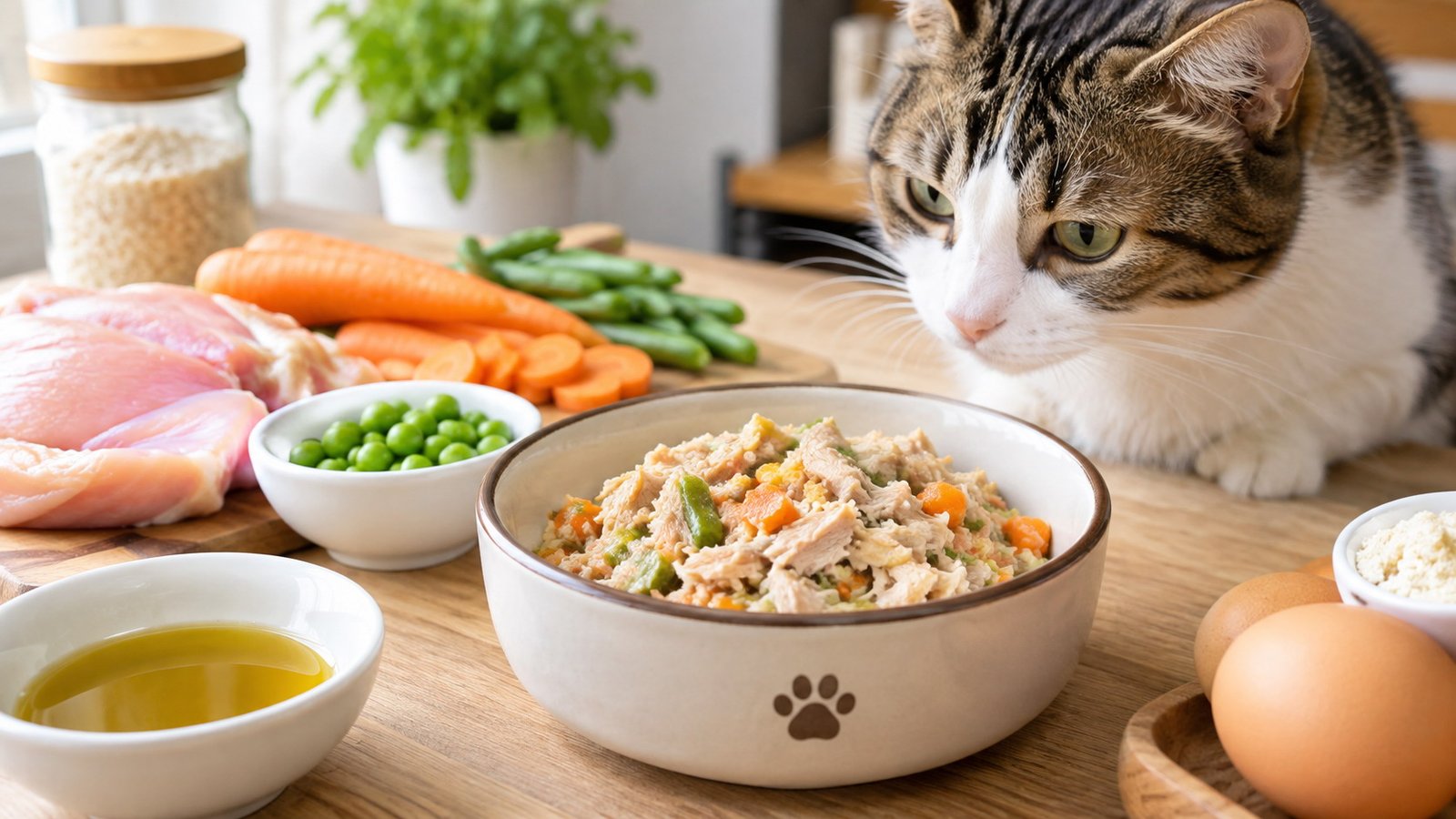
Homemade cooked cat food recipes can be a great way to give your cat fresh, carefully selected ingredients while having more control over what goes into each meal. However, preparing cat food at home involves more than simply cooking meat and putting it in a bowl.
Cats are obligate carnivores with nutritional requirements that are very different from humans. A homemade diet that looks healthy can still be deficient in important nutrients if it is not properly formulated. This guide explains how homemade cooked cat food works, which ingredients matter, how to prepare meals safely, and what mistakes can turn a seemingly nutritious recipe into an incomplete diet.
In This Article
Homemade Cooked Cat Food Recipes: What Cat Owners Should Know First
Cooking for your cat can feel rewarding, especially when you know exactly which ingredients are being used. Homemade meals may also be useful for cats with particular preferences or owners who want to incorporate fresh foods into their pet’s routine.
The biggest consideration, however, is nutritional completeness.
A bowl containing cooked chicken, vegetables, and rice might look wholesome to a person, but cats do not need a human-style balanced meal. Their bodies depend on nutrients found primarily in animal tissues, along with specific vitamins, minerals, amino acids, and fatty acids.
Homemade Food Is Not Automatically a Complete Diet
One of the most common misconceptions about homemade cat food is that using high-quality meat automatically creates a complete meal.
It does not.
Plain cooked meat can provide excellent protein, but it may not supply adequate amounts of several essential nutrients. Calcium is one obvious concern because boneless muscle meat contains very little calcium compared with the amount a cat requires.
Taurine is another major consideration. Cats have a high dietary requirement for taurine, and inadequate intake can cause serious health problems over time.
Fresh ingredients are valuable, but freshness and nutritional completeness are two different things.
Occasional Homemade Food vs. a Long-Term Diet
Homemade cooked food can serve different purposes depending on how it is formulated.
| Type of homemade food | Typical purpose | Nutritional consideration |
| Small cooked meat portions | Occasional treat | Does not need to replace a complete diet |
| Homemade food topper | Improve interest in regular food | Should remain a small part of the overall diet |
| Complete homemade diet | Long-term feeding | Requires careful formulation and appropriate supplements |
| Therapeutic homemade diet | Specific medical condition | Should be formulated with veterinary guidance |
The distinction matters because a recipe suitable as an occasional addition may be completely inadequate as the sole source of nutrition.
Cats also tend to be creatures of habit. A recipe that works beautifully for one cat may be rejected by another because of differences in smell, texture, temperature, or food preference.
What Makes Homemade Cat Food Different From Human Food?
Human meals often revolve around carbohydrates, vegetables, seasonings, sauces, and a variety of ingredients. Cats have no nutritional need for that style of meal.
A properly designed homemade cat food recipe generally puts animal-based protein and essential nutrients at the center of the formulation.
Avoid thinking of homemade cat food as a miniature version of dinner for people. The goal is to meet feline nutritional needs, not recreate a human recipe without salt or spices.
A Practical Rule for Cat Owners
Before making homemade cooked cat food part of your cat’s regular diet, ask yourself one important question:
Is this recipe nutritionally complete for my cat, or is it simply a healthy food addition?
Knowing the difference can prevent many long-term feeding problems.
Can Cats Safely Eat Homemade Cooked Food?
Yes, cats can eat appropriately prepared cooked foods, but safety depends on both the ingredients and the overall nutritional design.
Cooked meat can be an excellent component of a feline diet. Problems arise when owners assume that any combination of meat and other household ingredients is suitable for daily feeding.
Why Cooked Food Can Be a Good Option
Cooking provides several practical advantages.
Proper cooking can reduce the risk associated with pathogens that may be present in raw animal products. Cooked food can also be easier for some owners to handle, portion, refrigerate, and freeze.
Some cats simply prefer cooked food because of its aroma and texture.
Suitable ingredients can include meats such as:
- Chicken
- Turkey
- Beef
- Rabbit
- Certain types of fish
- Appropriate organ meats in controlled amounts
Never assume that an ingredient is safe simply because your cat enjoys eating it. Nutritional balance and food safety both matter.
Cats Have Nutritional Needs That Humans Don’t
Cats require nutrients that are especially important to their biology as obligate carnivores.
Important considerations include:
- High-quality animal protein
- Taurine
- Calcium
- Phosphorus in an appropriate balance
- Essential fatty acids
- Vitamin A
- Vitamin D
- B vitamins
- Other essential vitamins and minerals
- Adequate moisture
Some of these nutrients are difficult to provide consistently through ordinary grocery-store ingredients alone.
A homemade diet may therefore require a specifically designed feline vitamin and mineral supplement. Randomly adding supplements is not a safe substitute for proper formulation, because excessive amounts of certain nutrients can also cause harm.
Special Cats Need Extra Care
Homemade feeding deserves additional caution when the cat has special nutritional requirements.
Veterinary guidance is particularly important for:
- Kittens
- Pregnant or nursing cats
- Senior cats
- Underweight cats
- Overweight cats
- Cats with kidney disease
- Cats with urinary problems
- Cats with gastrointestinal disease
- Cats with liver disease
- Cats with food allergies or suspected intolerances
Growing kittens, for example, have different nutritional requirements from adult cats. A recipe that appears perfectly reasonable for an adult may not provide what a growing kitten needs.
Cats with diagnosed diseases can have even more specific dietary requirements.
When Homemade Food Should Not Replace Veterinary Care
Food can support good health, but it should never be used to self-treat an unexplained medical problem.
A cat that suddenly refuses food, repeatedly vomits, develops persistent diarrhea, loses weight, becomes unusually tired, or shows changes in thirst or urination needs appropriate veterinary evaluation.
Appetite loss deserves particular attention in cats. Prolonged refusal to eat can become medically serious, especially in overweight cats.
Owners should also avoid switching a sick cat to a homemade diet without first discussing the change with a veterinarian.
The Essential Ingredients Behind Balanced Homemade Cooked Cat Food Recipes
Building homemade cooked cat food requires more thought than choosing a protein and adding a few vegetables.
The recipe needs to provide the right nutrients in appropriate amounts. Ingredient quality matters, but proportion and formulation matter just as much.
Animal Protein Should Be the Foundation
Cats are designed to obtain much of their nutrition from animal tissues.
Common protein choices for homemade recipes include:
Chicken: Mild flavor, widely available, and often accepted by picky cats.
Turkey: Another lean poultry option that can add variety.
Beef: Provides substantial protein and can work well in appropriately formulated diets.
Rabbit: Useful as an alternative protein for some cats, particularly when dietary variety is desired.
Fish: Can be appealing to cats, but fish should not automatically become the primary protein in every homemade diet.
Different meats have different nutritional profiles. Swapping one meat for another can change the nutrient composition of a recipe, so substitutions should not be made casually when following a carefully formulated diet.
Organ Meat Can Be Valuable, but More Is Not Better
Organ meats can provide concentrated nutrients that are useful in feline nutrition.
Liver is particularly nutrient-dense and is commonly included in properly formulated homemade cat food recipes. The important point is moderation.
Feeding large amounts of liver simply because it is nutritious can create nutritional excesses.
Other organs may also have a role in certain formulations, but their inclusion should follow the specific recipe rather than guesswork.
Taurine Deserves Special Attention
Taurine is an essential nutrient for cats.
Unlike humans, cats have a limited ability to produce enough taurine to meet their needs, making dietary intake particularly important. Taurine supports normal functions involving the heart, eyes, reproduction, and other body systems.
Meat naturally contains taurine, but cooking and food handling can affect nutrient levels. Homemade diets therefore need careful formulation to ensure sufficient taurine remains available.
Never assume that a meat-only recipe automatically provides enough taurine for long-term feeding.
Calcium and Phosphorus Need to Work Together
Boneless muscle meat is naturally high in phosphorus and relatively low in calcium.
That imbalance becomes important when cats are fed homemade food as their primary diet.
Calcium is essential for normal bones, teeth, muscles, and other body functions. Simply adding a random calcium supplement, however, is not the ideal solution.
A properly formulated recipe calculates the appropriate amount and source based on the entire diet.
Don’t Forget Essential Fats and Micronutrients
Fat supplies energy and contributes essential fatty acids. The right amount depends on the individual recipe and the cat’s nutritional needs.
Vitamins and minerals also deserve careful attention. Meat alone cannot reliably supply every nutrient required for long-term feline health.
A complete homemade diet may therefore require a cat-specific nutritional supplement or premix designed for homemade diets, depending on the formulation.
Human multivitamins are not an appropriate replacement.
What About Vegetables and Carbohydrates?
Cats can digest some cooked plant ingredients, but vegetables and grains should not become the foundation of a homemade feline diet.
Small amounts may appear in certain professionally formulated recipes for specific nutritional or practical reasons. Their presence does not make a recipe inherently healthier.
The priority should remain on meeting the cat’s essential nutritional requirements rather than filling the bowl with ingredients that are considered healthy for humans.
A Simple Ingredient Checklist
Before preparing one of your homemade cooked cat food recipes, check whether the formulation accounts for:
- Animal-based protein
- Appropriate fat
- Taurine
- Calcium
- Appropriate calcium-to-phosphorus balance
- Essential fatty acids
- Required vitamins
- Required minerals
- Adequate moisture
- Appropriate calories for the individual cat
The safest homemade diet is one that has been deliberately formulated rather than improvised.
For reliable nutritional standards and guidance on complete and balanced pet diets, cat owners can also consult the AAFCO official website.
5 Easy Homemade Cooked Cat Food Recipes to Try
Homemade cooked cat food recipes can be prepared with simple ingredients, but simplicity should not be confused with nutritional completeness. The recipes below are best viewed as practical examples of cooked cat food combinations. Do not assume that a meat-only recipe is suitable as your cat’s sole long-term diet unless it has been properly formulated to meet feline nutritional requirements.
Simple Cooked Chicken Cat Food
Chicken is one of the easiest proteins to work with and is often well accepted by cats.
Basic ingredients:
- Boneless cooked chicken thigh or breast
- A small amount of the cooking liquid or plain water
- A properly formulated feline nutritional supplement, when required by the recipe
- Additional ingredients only when specified by a nutritionally complete formulation
Preparation:
- Cook the chicken thoroughly without salt, garlic, onion, butter, sauces, or seasoning.
- Allow it to cool enough to handle safely.
- Shred or finely chop the meat into bite-sized pieces.
- Add moisture so the finished food has a soft, appealing texture.
- Follow the directions for any cat-specific supplement being used.
- Divide the finished food into appropriate portions.
Chicken can work well as an occasional homemade food or topper. Plain chicken by itself should not replace a complete and balanced cat food for long-term feeding.
Turkey and Liver Homemade Cat Food
Turkey provides animal protein, while a controlled amount of liver can contribute important nutrients.
Basic ingredients:
- Cooked turkey
- A carefully measured amount of chicken or turkey liver
- Water or appropriate cooking liquid
- Cat-specific nutritional components required by the formulation
Cook the turkey and liver thoroughly without seasoning. Chop the ingredients finely and combine them while adding enough moisture to create a texture your cat enjoys.
Liver needs special attention because it is extremely nutrient-dense. More liver is not necessarily better. Excessive liver intake can contribute to excessive amounts of certain nutrients, so follow the proportions of a properly formulated recipe rather than adding liver freely.
Beef and Chicken Combination Recipe
Combining proteins can provide variety for cats that enjoy different flavors.
A simple combination might use cooked lean beef and chicken, with moisture added to improve texture and palatability.
Trim excessive visible fat before cooking, especially when a cat needs controlled calorie intake. Avoid fatty gravies, seasoning mixes, sauces, and processed meat products.
Changing the protein combination changes the nutritional profile. Long-term recipes should therefore be formulated around the exact ingredients and quantities being used.
Rabbit-Based Homemade Cat Food
Rabbit can provide another animal protein option for cats that enjoy novel flavors.
Cook boneless rabbit meat thoroughly and chop or mince it into a texture your cat can comfortably eat. A properly formulated rabbit-based diet should include the nutrients that are not adequately supplied by muscle meat alone.
Rabbit is sometimes discussed as an alternative protein for cats with suspected food sensitivities, but owners should not assume that changing proteins will diagnose or treat an allergy.
Cats with suspected food allergies need a carefully controlled diet under veterinary guidance.
Gentle Fish and Chicken Cat Food
Fish can be highly appealing because of its strong aroma, while chicken can provide a familiar protein.
Use plain, thoroughly cooked fish with all bones removed. Combine it with cooked chicken and the other nutritional components required by the recipe.
Fish should not simply be substituted into every homemade recipe without checking the formulation. Different fish species have different nutrient profiles, and some fish products may contain excessive salt or other unsuitable ingredients.
Fish-based meals are best incorporated thoughtfully rather than making heavily fish-based homemade food the default diet.
How to Make These Recipes More Practical
Meal preparation becomes much easier when you prepare food in small batches.
Try:
- Cooking meat in a plain batch without seasonings.
- Weighing ingredients instead of estimating portions by eye.
- Dividing finished food into individual meal portions.
- Refrigerating what will be used soon.
- Freezing additional portions for later.
- Labeling containers with the preparation date.
- Keeping your cat’s regular complete food available unless your veterinarian has recommended a full dietary transition.
Avoid changing a nutritionally formulated recipe by casually adding or removing ingredients. Even seemingly minor changes can alter calories, minerals, fat, and other nutrients.
How to Cook Homemade Cat Food Without Losing Safety or Quality
Safe preparation matters just as much as ingredient selection. Homemade cat food contains animal products that can spoil or become contaminated if they are handled incorrectly.
Good kitchen hygiene protects both your cat and the people preparing the food.
Start With Safe Meat Handling
Keep raw meat separate from foods intended for people.
Wash your hands after handling raw ingredients and clean preparation surfaces, cutting boards, knives, and utensils thoroughly.
Avoid leaving raw meat sitting at room temperature for extended periods.
A simple preparation routine can reduce contamination risks:
- Prepare the raw ingredients on a clean surface.
- Keep raw meat away from ready-to-eat foods.
- Cook the meat thoroughly.
- Clean utensils and surfaces after handling raw ingredients.
- Cool the finished food promptly.
- Refrigerate or freeze portions appropriately.
Cook Meat Thoroughly
Homemade cooked cat food should be made from properly cooked animal ingredients rather than partially cooked meat.
Cooking meat thoroughly helps reduce exposure to harmful microorganisms.
Do not add:
- Salt
- Garlic
- Onion
- Spicy seasonings
- Sauce
- Bouillon
- Human gravy
- Seasoning packets
- Butter-heavy sauces
Cats do not need human-style seasoning to enjoy their food. Their sense of smell plays a major role in food acceptance, so the natural aroma of properly cooked meat can be enough.
Be Careful With Bones
Never give cooked bones to your cat.
Cooked bones can become brittle and may splinter into sharp pieces. Those fragments can cause choking, mouth injuries, gastrointestinal damage, or intestinal obstruction.
Boneless meat is generally much easier to handle when preparing homemade cooked food.
Calcium should instead come from an appropriate, measured source in a properly formulated recipe.
Don’t Guess When Adding Supplements
Supplements are one of the areas where well-meaning owners can accidentally create problems.
Adding a little extra taurine, calcium, vitamin powder, or another nutrient may seem harmless, but nutritional requirements are based on the entire diet.
A homemade diet should use the correct supplement, in the correct amount, according to the formulation being followed.
Human supplements should not be substituted simply because the label lists similar vitamins or minerals.
Texture and Moisture Matter
Cats can be surprisingly particular about texture.
Some prefer finely minced food, while others enjoy shredded meat or a softer pâté-like consistency.
Adding appropriate water can also increase moisture intake, which is one of the practical advantages of wet-style homemade meals.
Try to maintain a texture your cat accepts rather than changing it dramatically from one batch to another.
Introduce Homemade Food Gradually
Cats may reject a new food simply because it smells or feels unfamiliar.
A gradual transition is often easier than replacing the regular food overnight.
You can start by offering a small amount alongside the familiar diet and gradually increase the new food if your cat accepts it.
Watch for:
- Vomiting
- Diarrhea
- Refusal to eat
- Sudden changes in stool
- Reduced appetite
- Unusual lethargy
Never force a cat to eat an unfamiliar food. Persistent food refusal deserves veterinary attention, particularly because cats can become seriously ill when they go without adequate food for too long.
Ingredients You Should Never Add to Homemade Cooked Cat Food
One of the biggest advantages of homemade cat food is controlling the ingredients. That advantage disappears if unsafe human-food ingredients are added during preparation.
A recipe that smells delicious to you may contain ingredients that are inappropriate or dangerous for a cat.
Avoid Onions, Garlic, and Related Ingredients
Onions and garlic should never be intentionally added to cat food.
The same caution applies to concentrated forms such as:
- Onion powder
- Garlic powder
- Garlic salt
- Onion salt
- Seasoning blends containing onion or garlic
- Certain sauces and broths containing these ingredients
These ingredients can be particularly easy to overlook because they may appear in commercial seasoning mixes rather than as obvious pieces of onion or garlic.
Read labels carefully whenever you use a packaged ingredient.
Skip Excessive Salt and Seasonings
Cats have no need for heavily salted food.
Avoid turning homemade cat food into a seasoned human meal. Salt, pepper, chili, curry blends, seasoning packets, and flavored sauces should stay out of the preparation.
Plain cooked meat is the safer approach.
Keep Chocolate, Alcohol, and Caffeine Away
Chocolate, alcoholic beverages, and caffeinated products have no place in a cat’s diet.
Never use coffee, tea, cocoa, alcoholic cooking ingredients, or chocolate-containing products as flavoring.
Store these products where pets cannot accidentally access them.
Be Careful With Sweeteners and Processed Foods
Certain human foods contain ingredients that can be harmful to pets, while processed foods may contain excessive salt, fat, or seasonings.
Homemade cat food does not need sweeteners, dessert ingredients, flavored syrups, or processed snack foods.
The safest recipe is usually much simpler than a human recipe.
Don’t Use Cooked Bones as a Calcium Shortcut
Some owners assume that grinding cooked bones into homemade cat food is an easy way to supply calcium.
That approach can be dangerous.
Cooked bones may splinter and can create an unpredictable mineral composition. Calcium supplementation should come from an appropriate source measured according to a properly formulated feline diet.
Avoid Fatty Human Leftovers
Table scraps such as bacon, sausage, fried meat, heavily seasoned leftovers, and rich gravies are poor foundations for homemade cat food.
High-fat foods can also cause digestive upset in some cats.
A better approach is to prepare plain ingredients specifically for the cat rather than modifying leftovers from the family dinner.
Quick Safety Checklist
Before serving homemade cooked cat food, check that it contains:
- No onion or garlic
- No chocolate or caffeine
- No alcohol
- No cooked bones
- No spicy seasonings
- No heavily salted ingredients
- No sauces or seasoning mixes
- No questionable human supplements
- No spoiled or improperly stored ingredients
When a homemade diet is intended to provide all of your cat’s daily nutrition, ingredient safety is only one part of the equation. The complete recipe still needs to meet the cat’s nutritional requirements.
Homemade Cooked Cat Food vs. Commercial Cat Food: Which Is Better?
Choosing between homemade cooked cat food and commercial cat food is not simply a matter of deciding which option looks more natural. The better choice is the one that reliably provides your cat with complete nutrition, appropriate calories, safe ingredients, and a diet they will actually eat.
Homemade food gives owners greater control over ingredients, but commercial cat food has an important advantage: reputable complete diets are formulated to provide the nutrients cats need in appropriate proportions.
Homemade Cat Food: Where It Shines
Homemade cooked food can be appealing because you control the ingredients and preparation process.
Potential advantages include:
- Greater control over protein sources
- Ability to control added ingredients
- Freshly prepared meals
- Flexible texture and moisture
- Potentially useful for cats with particular food preferences
- Ability to prepare small portions for cats that dislike food sitting open for long periods
Some cats are simply more enthusiastic about freshly cooked meat than dry food or certain canned textures.
Commercial Cat Food: Why It Remains Popular
Complete commercial cat food offers convenience and nutritional consistency.
A properly formulated product can provide the required vitamins, minerals, amino acids, fatty acids, protein, and energy without requiring the owner to calculate every nutrient.
Commercial foods also make portioning and storage easier.
Convenience is not a nutritional weakness. A complete commercial diet can be an excellent choice for a cat when it is appropriate for that individual animal.
A Practical Comparison
| Factor | Homemade Cooked Cat Food | Commercial Cat Food |
| Ingredient control | High | Depends on product |
| Preparation time | Higher | Very low |
| Nutritional formulation | Requires careful planning | Usually handled by manufacturer |
| Storage | Requires meal preparation | Easier, depending on format |
| Texture customization | Very flexible | Limited to available varieties |
| Cost | Varies widely | Varies widely |
| Long-term nutritional consistency | Depends on recipe accuracy | Generally more consistent |
| Veterinary diet options | Requires professional formulation | Specialized products are widely available |
Which Option Should You Choose?
There is no universal answer.
Some owners prefer commercial food because it is simple and nutritionally consistent. Others enjoy preparing homemade meals and are willing to put more effort into formulation, portioning, and food safety.
A combination approach may also work for some cats. For example, a cat might receive a complete commercial diet as its nutritional foundation while receiving small amounts of appropriate homemade cooked food as a topper or occasional treat.
The key is to avoid allowing unbalanced homemade food to gradually replace the complete portion of the diet.
Common Mistakes That Can Turn Homemade Cat Food Into an Unbalanced Diet
Many homemade cat food problems begin with good intentions. Owners want to provide fresh, wholesome food, but a recipe that looks healthy can still lack essential nutrients.
Understanding the most common mistakes makes homemade feeding much safer.
Feeding Only Cooked Chicken
Plain chicken is nutritious, but it is not a complete feline diet.
Chicken muscle meat does not provide all the calcium, vitamins, minerals, taurine, and other nutrients a cat needs for long-term health.
Chicken can be an ingredient. It should not automatically become the entire diet.
Leaving Out Taurine
Taurine deserves particular attention because cats depend heavily on dietary taurine.
A homemade diet needs to account for adequate taurine rather than assuming that the meat portion will always provide enough.
Long-term deficiency can have serious consequences.
Adding Too Much Liver
Liver is nutrient-rich, making it useful in some properly formulated recipes.
More is not better.
Large amounts of liver can provide excessive levels of certain nutrients, particularly vitamin A. Follow the amount specified in a properly formulated recipe rather than increasing the liver portion because your cat enjoys it.
Ignoring Calcium
This mistake is especially common when owners prepare recipes using boneless meat.
Meat contains phosphorus but does not provide enough calcium to create the appropriate balance by itself.
A homemade diet based heavily on boneless muscle meat needs a carefully calculated calcium source.
Using Human Recipes as a Template
A recipe designed for people should not be converted into cat food simply by removing salt.
Human meals often contain ingredients that cats do not need and may not tolerate well.
Human recipes can also have completely different nutritional priorities.
Making Unplanned Ingredient Substitutions
Suppose a carefully formulated recipe calls for turkey and you decide to replace half of it with fish. The finished diet may no longer have the same nutritional composition.
Ingredient substitutions can change:
- Protein levels
- Fat content
- Calories
- Calcium
- Phosphorus
- Taurine
- Vitamin levels
- Mineral levels
Treat a nutritionally formulated homemade recipe more like a formula than a casual cooking suggestion.
Assuming “Natural” Means “Balanced”
Natural ingredients can still create an unbalanced diet.
Fresh chicken, beef, rabbit, or fish may be excellent foods, but combining several natural ingredients does not guarantee that the final meal meets every nutritional requirement.
The same principle applies to homemade treats. Healthy ingredients are not necessarily complete meals.
Forgetting About Calories
Nutritional balance is important, but calorie intake matters too.
A cat can gain weight from a diet made entirely from wholesome ingredients if the portions provide more energy than the cat needs.
Monitor your cat’s body condition, weight trends, activity level, and appetite rather than assuming that homemade food can be fed without portion control.
Changing Recipes Too Frequently
Variety sounds appealing to humans, but constantly changing a cat’s diet can make it difficult to determine what is causing digestive problems or food refusal.
A consistent, properly formulated diet is usually easier to monitor.
How Much Homemade Cooked Cat Food Should You Feed?
There is no single portion size that works for every cat.
The amount of homemade cooked food a cat needs depends on factors such as body size, age, activity, reproductive status, current weight, body condition, and overall health.
Start With Your Cat’s Individual Needs
Two cats weighing the same amount can have different calorie requirements.
An active young adult may need more energy than a sedentary indoor cat. A cat that needs to lose weight will also require a different feeding plan from an underweight cat recovering from illness.
Consider:
- Current body weight
- Ideal body weight
- Activity level
- Age
- Neuter status
- Body condition
- Health status
- Calorie density of the recipe
Portion size should be based on the nutritional content of the finished recipe, not simply the number of cups or spoonfuls.
A Simple Feeding Framework
Use the recipe’s calculated calorie content to determine how much food your cat needs.
For example, if a properly formulated homemade recipe provides a specific number of calories per 100 grams, your cat’s daily calorie target can be divided according to the number of meals you provide.
This approach is much more accurate than saying that every cat should receive a fixed amount of homemade food.
Monitor Body Condition
Your cat’s body condition provides useful information about whether the feeding amount is appropriate.
Signs that portions may need adjustment include:
- Gradual unexplained weight gain
- Noticeable weight loss
- Ribs becoming increasingly difficult to feel
- Ribs becoming unusually prominent
- Reduced activity
- Persistent hunger
- Food consistently being left uneaten
Weight should be monitored over time rather than judged from a single day.
How Often Should You Feed Homemade Cat Food?
Many adult cats do well with meals divided into two or more daily feedings, while some prefer smaller meals throughout the day.
Your cat’s individual routine matters.
Kittens generally need more frequent feeding because they are growing rapidly and have different nutritional requirements from adult cats.
Cats with certain medical conditions may also require specific feeding schedules recommended by their veterinarian.
Transition to Homemade Food Gradually
Cats can be sensitive to sudden dietary changes.
Rather than replacing the familiar food with a full serving of homemade food immediately, introduce the new food gradually when appropriate.
A transition might look like:
- Offer a small amount of the new food.
- Keep the familiar food available.
- Increase the new food slowly if your cat accepts it.
- Watch for digestive changes.
- Maintain adequate food intake throughout the transition.
Never allow a cat to go without eating simply because it refuses a new recipe.
A cat’s willingness to eat is an important part of successful nutrition. If your cat repeatedly refuses food or develops concerning symptoms during a diet change, stop experimenting and speak with a veterinarian.
How to Store Homemade Cooked Cat Food Safely
Preparing homemade cooked cat food in batches can save time and make daily feeding easier. Proper storage is essential, though, because cooked meat can spoil quickly when left at unsafe temperatures.
Good storage habits also help preserve the food’s texture and smell, which can make a difference for cats that are particular about freshness.
Refrigerate Freshly Prepared Food Promptly
Once the food has been cooked, divide it into smaller portions so it can cool more efficiently.
Place portions in clean, airtight containers and refrigerate them promptly rather than leaving a large batch sitting at room temperature for an extended period.
Keep the refrigerator cold and avoid repeatedly taking the entire batch out whenever your cat needs a meal.
Only keep a reasonable amount in the refrigerator for short-term use. Freeze the rest if you will not use it soon.
Freeze Individual Portions
Freezing homemade cat food is convenient when preparing several days or weeks of meals at once.
Portion the food according to your cat’s usual meal size before freezing. Small containers, freezer-safe bags, or silicone portion trays can make this process easier.
Label each portion with:
- Preparation date
- Recipe or protein type
- Any relevant supplement information
- Intended feeding date, if useful
Individual portions also reduce waste because you only thaw what your cat needs.
Thaw Homemade Cat Food Safely
The refrigerator is generally the most practical place to thaw frozen cat food.
Avoid leaving frozen meat-based food sitting on the kitchen counter for prolonged periods.
Never refreeze food that has been completely thawed and left at unsafe temperatures.
If your cat prefers food closer to room temperature, gently warm the thawed portion rather than serving it very cold. Never make the food hot enough to burn your cat’s mouth.
What About Uneaten Food?
Cats can be unpredictable eaters. One day they may finish everything, while the next day they may walk away after a few bites.
Do not repeatedly return food that has been sitting out for an extended period.
Remove leftovers according to appropriate food-safety practices, clean the bowl, and provide a fresh portion at the next meal.
Covered storage also helps prevent contamination from other household foods, insects, and kitchen surfaces.
A Simple Meal-Prep Routine
A practical weekly routine can look like this:
- Prepare the properly formulated recipe.
- Divide it into individual portions.
- Refrigerate portions intended for immediate use.
- Freeze portions that will be used later.
- Label containers clearly.
- Thaw the next portion in the refrigerator.
- Serve an appropriate amount at mealtime.
- Clean the feeding bowl after use.
Consistency makes homemade feeding much easier to manage safely.
Expert Tips for Making Homemade Cat Food More Appealing to Picky Cats
Even a carefully formulated recipe is useless if your cat refuses to eat it.
Cats rely heavily on smell when deciding whether food is appealing. Texture, temperature, freshness, and familiarity can also influence their response.
Introduce New Food Slowly
A cat accustomed to commercial food may not immediately recognize homemade food as something worth eating.
Start with a small amount rather than presenting an entirely different meal.
Gradual changes can help your cat become familiar with the new smell and texture without creating unnecessary stress.
Pay Attention to Texture
Some cats prefer finely minced food, while others prefer shredded pieces.
You can experiment with appropriate textures such as:
- Finely minced
- Softly chopped
- Shredded
- Moist pâté-style
- Small tender pieces
Avoid large, tough chunks that may be difficult to chew.
Add Moisture When Appropriate
Many cats enjoy moist food.
Adding an appropriate amount of plain water to a homemade recipe can create a softer consistency and increase moisture intake.
Avoid using salty broth, gravy, seasoning mixes, or stock containing onion or garlic.
Serve Food at an Appealing Temperature
Very cold food straight from the refrigerator may be less appealing to some cats.
Allowing refrigerated food to warm slightly before serving can make its aroma more noticeable.
If you warm food, mix it thoroughly and check the temperature before serving.
Warm, aromatic food can sometimes be more tempting than food served cold.
Avoid Constantly Changing the Recipe
It can be tempting to keep experimenting when a cat is picky.
Constantly switching between chicken, beef, fish, rabbit, and other recipes can make it difficult to determine which foods your cat actually prefers.
A better approach is to identify a nutritionally appropriate recipe your cat accepts and keep the routine relatively consistent.
Know When Pickiness Could Be a Health Problem
Not every food refusal is behavioral.
A cat that suddenly stops eating may have dental pain, gastrointestinal problems, nausea, stress, or another underlying issue.
Watch for additional warning signs such as:
- Repeated vomiting
- Diarrhea
- Drooling
- Difficulty chewing
- Weight loss
- Hiding
- Unusual tiredness
- Changes in drinking
- Changes in urination
- Persistent refusal of food
Sudden or prolonged appetite loss should not be treated simply as pickiness.
When Homemade Cat Food Needs Veterinary Guidance
Homemade cooked cat food can be managed safely when owners understand the nutritional requirements and follow a properly formulated recipe. Certain cats, however, require additional care.
Veterinary guidance becomes especially important when homemade food will be the primary or exclusive diet.
Kittens Need Special Nutritional Planning
Kittens are growing rapidly and need carefully balanced nutrition to support bones, muscles, organs, and normal development.
An adult homemade cat food recipe should not automatically be used for a kitten.
Never assume that a recipe suitable for an adult cat is automatically suitable for growth.
Cats With Medical Conditions May Need Therapeutic Nutrition
Cats with kidney disease, urinary problems, liver disease, diabetes, gastrointestinal disorders, or other health conditions may have very specific dietary requirements.
A homemade recipe that is healthy for a normal adult cat may be inappropriate for a cat with a medical condition.
Therapeutic diets should therefore be developed with veterinary guidance rather than improvised from online recipes.
Watch for Signs That Something Is Wrong
Contact your veterinarian when your cat develops concerning changes such as:
- Persistent vomiting
- Recurrent diarrhea
- Significant weight loss
- Refusal to eat
- Severe lethargy
- Difficulty swallowing
- Pain while eating
- Sudden changes in thirst
- Significant changes in urination
- Persistent digestive problems
Food can play an important role in health, but dietary experimentation should never delay evaluation of a potentially serious illness.
Consider Professional Recipe Formulation
Owners who want homemade food to make up most or all of their cat’s diet can benefit from having the recipe evaluated or formulated by a veterinary nutrition professional.
Professional formulation can help account for:
- Calories
- Protein
- Fat
- Calcium
- Phosphorus
- Taurine
- Vitamins
- Minerals
- Essential fatty acids
- The cat’s age and health status
The goal is not simply to create food that looks healthy. The goal is to create a diet that meets the cat’s nutritional requirements consistently.
FAQs About Homemade Cooked Cat Food Recipes
Can I feed my cat homemade cooked food every day?
Yes, but daily homemade food should be properly formulated to provide complete and balanced nutrition. Plain cooked meat should generally be treated as an occasional food or topper rather than the sole long-term diet.
What meat is best for homemade cat food?
Chicken, turkey, beef, rabbit, and certain fish can all be used in appropriately formulated cat food. No single meat is automatically the best choice for every cat, and changing the main protein can change the nutritional composition of the recipe.
Can cats eat cooked chicken every day?
Cats can eat plain cooked chicken, but chicken alone does not provide every nutrient required for a complete feline diet. Long-term feeding of chicken-only meals can create nutritional deficiencies.
Do homemade cat food recipes need supplements?
Many homemade diets require carefully selected supplements because ordinary meat and other grocery-store ingredients do not provide every nutrient cats need in the correct amounts. Supplements should be used according to a properly formulated recipe rather than added randomly.
Can I use chicken liver in homemade cat food?
Chicken liver can be included in some homemade cat food recipes because it provides concentrated nutrients. The amount needs to be controlled because excessive liver can provide too much of certain nutrients.
How long does homemade cat food last in the refrigerator?
Homemade cooked cat food should be handled as a perishable meat-based food. Refrigerate it promptly, keep it in clean airtight containers, and use short-term refrigerated portions rather than keeping a large batch for an extended period. Freeze portions that will not be used soon.
Can kittens eat homemade cooked cat food?
They can eat appropriately formulated cooked food, but kittens have different nutritional requirements from adult cats. A homemade kitten diet should be specifically formulated for growth and should not simply be adapted from an adult recipe.
Is homemade cat food healthier than commercial cat food?
Not automatically. Homemade food provides ingredient control, but commercial complete diets have the advantage of consistent nutritional formulation. Homemade food is only a healthier choice when it is nutritionally appropriate for the individual cat.
How do I transition my cat to homemade food?
Introduce the new food gradually while monitoring appetite, stool quality, and overall behavior. Avoid forcing a cat to eat a new recipe, and seek veterinary advice if your cat refuses food or develops concerning symptoms.
Can I replace commercial cat food with homemade cooked cat food?
You can choose a properly formulated homemade diet, but replacing complete commercial food with an improvised recipe can create nutritional deficiencies. Long-term homemade feeding should be based on a nutritionally complete formulation appropriate for your cat.
Can I add vegetables to homemade cooked cat food?
Small amounts of certain vegetables may appear in some formulations, but vegetables should not replace the animal-based nutrients cats require. A homemade cat diet should be designed around feline nutritional needs rather than human ideas about a balanced meal.
Can I use homemade cat food as a topper?
Yes, small amounts of appropriate plain cooked meat can be used as a topper for some cats. Keep toppers limited so they do not displace too much of the nutritionally complete food that provides the majority of the diet.
Make Homemade Cat Food a Safe, Thoughtful Part of Your Cat’s Routine
Homemade cooked cat food recipes can give cat owners more control over ingredients, moisture, preparation, and texture. The biggest challenge is making sure that fresh ingredients also provide the nutrients a cat needs for long-term health.
Start with nutrition rather than the recipe itself. Choose appropriate animal proteins, use safe preparation methods, avoid dangerous ingredients, measure portions carefully, and store cooked food properly.
Owners who want homemade food to become a major part of their cat’s diet should take the extra step of using a properly formulated recipe and discussing long-term feeding with a veterinarian or qualified veterinary nutrition professional.
A thoughtful approach can make homemade feeding safer, more practical, and more enjoyable for both you and your cat.