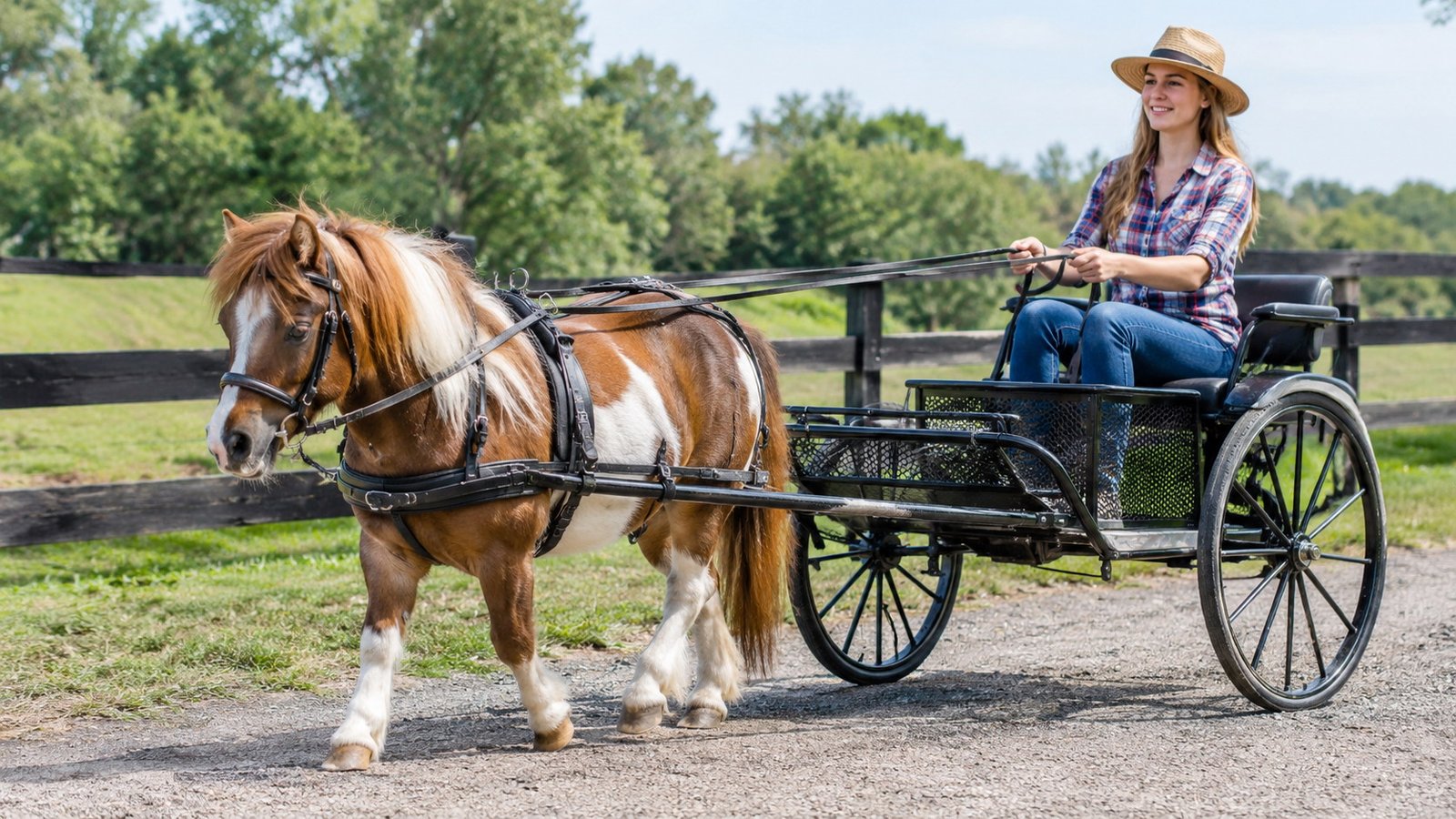
Understanding American Miniature Horse pulling carriage weight capacity is essential before hitching a cart or carriage to your horse. Although these small horses can be surprisingly strong and are well suited to driving, safe pulling capacity depends on much more than the horse’s body weight.
The right carriage, harness fit, terrain, distance, conditioning, and total load all affect how much work a miniature horse can comfortably handle. This guide explains how to think about carriage weight capacity, what affects pulling ability, and how to evaluate a setup before asking your miniature horse to work.
In This Article
How Much Weight Can an American Miniature Horse Pull?
The biggest mistake owners make is looking for one universal number and assuming it applies to every American Miniature Horse. There is no single pound limit that safely describes every miniature horse and every carriage combination.
The American Miniature Horse Association notes that miniature horses are highly capable driving animals and states that they can pull a cart carrying one to two adults under appropriate circumstances. The same organization lists the average adult miniature horse at approximately 150–250 pounds, illustrating why individual size, fitness, and conditioning matter when evaluating a driving setup.
That information should not be interpreted as permission to place any two adults in any cart behind any miniature horse. The total workload includes the carriage itself, passengers, equipment, and anything else being transported.
Carriage Weight Is Part of the Load
Suppose a miniature horse is pulling:
- A lightweight driving cart
- One adult passenger
- A harness and driving equipment
- Personal items carried in the cart
The horse is moving the combined weight, not simply the passenger.
This distinction becomes particularly important when comparing a lightweight two-wheel training cart with a heavier recreational carriage. Two carriages designed for miniature horses can have dramatically different weights and rolling characteristics.
A lighter, properly balanced cart generally places less physical demand on the horse than a heavy or poorly balanced carriage.
There Is a Difference Between Pulling and Carrying
Driving is fundamentally different from riding.
When a miniature horse pulls a properly balanced wheeled vehicle, the load is supported by the wheels rather than being placed directly on the horse’s back. The horse still has to overcome rolling resistance, acceleration, hills, uneven ground, and the effects of the vehicle’s balance.
That is one reason miniature horses can be useful driving animals despite their small size. AMHA specifically identifies driving as one of the activities in which American Miniature Horses participate.
Pulling a carriage does not mean the horse can safely handle an unlimited amount of weight. The mechanical setup matters just as much as the number on a scale.
What Determines American Miniature Horse Carriage Weight Capacity?
Several factors work together to determine whether a particular miniature horse and carriage combination is reasonable.
The Horse’s Body Size and Condition
Two miniature horses may both fall within a similar weight range while having very different physiques.
A well-muscled, mature horse with good conditioning may handle driving work differently from an overweight, under-muscled, elderly, or poorly conditioned horse.
Pay attention to:
- Overall body condition
- Muscle development
- Age and maturity
- Fitness level
- Previous driving experience
- Hoof condition
- Soundness and gait
- Breathing and recovery after exercise
Body weight alone is not a complete measure of working capacity.
A horse that looks strong standing in a pasture may still need gradual conditioning before pulling a carriage regularly.
The Weight of the Carriage
Carriage weight should be one of the first numbers you identify when calculating the total load.
A lightweight miniature-horse cart can be substantially easier to move than a heavy carriage. Wheel size, tire type, axle design, construction materials, and overall condition can all influence rolling resistance.
A useful starting calculation is:
Total load = carriage weight + passenger weight + equipment + cargo
For example, if a carriage weighs 80 pounds and the passenger weighs 150 pounds, the horse is dealing with at least 230 pounds before adding harness and other equipment.
That does not mean 230 pounds is automatically safe or unsafe. It simply demonstrates why looking only at passenger weight can give owners an incomplete picture.
Terrain Changes the Workload
A miniature horse pulling a carriage on a level, firm surface faces a different workload from one traveling over soft ground or hills.
Terrain that can increase physical demand includes:
- Steep inclines
- Deep sand
- Mud
- Loose gravel
- Tall grass
- Rough trails
- Frequent starts and stops
Downhill travel also deserves attention because the horse may need to help control the movement of the carriage rather than simply pull it forward.
A load that feels manageable on flat ground may become much more demanding on a hill.
Distance and Speed Matter
Pulling a carriage for a short distance at a controlled walk is not equivalent to working continuously for several miles.
Driving workload increases with:
- Longer distances
- Faster speeds
- Frequent acceleration
- Repeated hill climbing
- Hot or humid weather
- Poor footing
- Inadequate conditioning
A sensible driving program builds duration gradually instead of immediately testing the horse’s maximum ability.
Harness Fit and Carriage Balance Matter
Even an appropriately sized load can become uncomfortable if the harness does not fit correctly or the carriage is poorly balanced.
A properly fitted driving harness should allow the horse to move freely without excessive pressure or rubbing. The shafts, traces, breeching, breastcollar, saddle, and other components should work together as part of a correctly designed driving system.
The carriage itself should also be appropriate for the horse’s size.
Weight capacity should never be considered separately from harness fit, carriage balance, and braking or control systems.
For official breed and driving information, the American Miniature Horse Association’s current rulebook is a useful reference for owners involved in miniature-horse driving and competition.
How to Calculate the Total Load Before Driving
Before hitching your American Miniature Horse to a carriage, weigh or estimate every major component rather than focusing only on the passenger.
Make a Simple Load List
Record:
| Load component | What to include |
| Carriage | Complete empty carriage weight |
| Driver | Person sitting in the vehicle |
| Passenger | Additional passenger if applicable |
| Harness | Harness and driving equipment |
| Cargo | Bags, supplies, equipment, etc. |
| Total | Combined working load |
This simple calculation helps reveal why a seemingly light passenger can become a much heavier overall load once the carriage and equipment are included.
Don’t Treat a Maximum as a Target
A horse’s ability to pull a particular setup does not mean the owner should routinely operate at its upper limit.
The goal of driving should be comfortable, controlled work rather than finding the greatest possible load the horse can move.
Watch how the horse responds during and after work. Difficulty maintaining a normal gait, excessive sweating, unusual breathing, reluctance to move, repeated stopping, or signs of soreness should be treated as reasons to stop and reassess the setup.
Gradual conditioning, appropriate footing, correct harness fit, and regular evaluation are much more useful than relying on a single maximum-weight number.
What Are the Signs an American Miniature Horse Is Carrying Too Much Pulling Weight?
Recognizing signs of excessive workload is just as important as calculating carriage weight. A miniature horse may continue moving even when the workload is becoming uncomfortable, so owners should pay attention to subtle changes in movement, breathing, attitude, and recovery.
Watch for Changes in Movement
A comfortable driving horse should move willingly and maintain a reasonably consistent gait. Changes that may indicate the workload is too demanding include:
- Shortened or irregular steps
- Frequent stopping without an obvious reason
- Reluctance to move forward
- Difficulty starting the carriage from a standstill
- Dragging the hind feet
- Stiffness after work
- Repeated head tossing or other signs of discomfort
- Difficulty maintaining a normal walking or trotting rhythm
One concerning sign does not automatically prove that the carriage is too heavy. Harness discomfort, poor footing, pain, lack of conditioning, or another physical problem can produce similar behavior.
The important point is to avoid simply asking the horse to work harder when its movement changes.
Pay Attention to Breathing and Recovery
Breathing naturally becomes faster during exercise. The concern is whether the horse appears to be struggling beyond what would reasonably be expected from the intensity and conditions.
Give the horse regular opportunities to rest, particularly when introducing carriage work or driving in warm weather.
Watch how quickly the horse settles after stopping. Unusually prolonged recovery, extreme sweating, weakness, or obvious respiratory distress should be treated seriously.
Stopping the session and seeking veterinary advice is appropriate when physical signs are severe, persistent, or unusual for that individual horse.
Behavior Can Tell You Something Too
Some miniature horses become reluctant to approach the carriage or repeatedly resist being hitched when they are uncomfortable.
Other warning behaviors can include:
- Pinning the ears during harnessing
- Repeatedly backing away
- Tail swishing excessively
- Bucking or kicking at the equipment
- Refusing to move once hitched
- Becoming unusually irritable
- Trying repeatedly to stop
Behavior alone cannot determine the cause. Pain, fear, poor training, harness pressure, carriage balance, and excessive workload can all contribute to resistance.
Rather than correcting the horse for refusing to pull, inspect the entire driving setup.
How to Choose a Carriage for an American Miniature Horse
Selecting the right carriage can make a significant difference to comfort and safety. The smallest carriage is not automatically the best choice, and the heaviest recreational carriage is rarely appropriate simply because the horse can physically move it.
Start With the Horse’s Size
American Miniature Horses vary considerably in height, build, bone structure, and body weight.
A carriage should be designed or appropriately sized for the horse rather than selected solely because it is inexpensive or attractive.
Consider:
- Horse height and body proportions
- Wheel and shaft dimensions
- Harness compatibility
- Carriage weight
- Seat capacity
- Ground clearance
- Wheel design
- Braking or stopping arrangements
- Intended driving surface
The carriage and harness should function as one system.
A poorly matched carriage can create unnecessary pressure even when its total weight appears reasonable.
Lightweight Does Not Always Mean Better
Lightweight construction can reduce the amount of weight being pulled, but stability and balance remain important.
A very light cart with poor balance may create handling problems, while a slightly heavier but properly designed carriage may roll more predictably.
Owners should therefore look beyond the number printed on a carriage specification sheet.
Ask:
- How much does the complete carriage weigh?
- Is it designed specifically for miniature horses?
- Is the horse large enough and conditioned enough for the intended use?
- Does the harness fit the carriage correctly?
- Will the carriage remain stable on the intended terrain?
- Can the driver control and stop it safely?
Two-Wheel Carts and Four-Wheel Carriages
Two-wheel carts and four-wheel carriages distribute their loads differently.
A properly balanced two-wheel cart can be relatively simple and lightweight, but the shafts and balance need to be correct because the horse is connected closely to the vehicle.
Four-wheel carriages can offer a different driving experience and may provide additional stability, but their construction can also make them substantially heavier.
| Carriage type | Main consideration |
| Lightweight two-wheel cart | Low vehicle weight and proper balance |
| Heavier recreational cart | Greater total load and rolling resistance |
| Four-wheel carriage | Stability, weight, and appropriate harness setup |
| Training cart | Controlled introduction to driving |
| Competition-style vehicle | Horse size, rules, balance, and intended discipline |
Choose the vehicle based on the horse, driver, terrain, and intended activity rather than appearance alone.
How to Condition an American Miniature Horse for Carriage Work
Even an appropriately sized American Miniature Horse should not be expected to pull a full carriage load immediately.
Driving fitness develops progressively. Muscles, cardiovascular fitness, coordination, confidence, and familiarity with the equipment all need time to develop.
Begin With Basic Ground Training
Before attaching a carriage, the horse should understand basic commands and respond reliably to the handler.
Useful foundations include:
- Leading calmly
- Stopping on command
- Standing quietly
- Turning both directions
- Backing when asked
- Accepting harness equipment
- Remaining calm around unfamiliar sounds
- Walking forward willingly
A horse that cannot stop reliably on the ground should not be rushed into carriage driving.
Introduce the Harness Gradually
Let the horse become comfortable wearing the harness before adding the vehicle.
Check for rubbing, pinching, restricted movement, or unusual behavior during each session. The horse should be able to walk freely and comfortably while wearing the equipment.
Spend time allowing the horse to become familiar with the sounds and sensations associated with driving.
Confidence is part of conditioning. A physically capable horse that is frightened of the carriage is not ready for a demanding driving session.
Increase Workload Slowly
Once the horse understands the basics, increase the workload in small stages.
A sensible progression might involve:
- Ground work and leading
- Harness familiarization
- Light training equipment
- Short sessions with a suitable cart
- Gradually longer sessions
- Gradual introduction of additional passenger weight
- More varied terrain only after basic fitness is established
The exact pace should be adjusted to the individual horse.
Avoid increasing weight, distance, speed, and difficult terrain at the same time. Changing one variable at a time makes it easier to determine how the horse is responding.
Give the Horse Time to Recover
Rest days are part of training rather than wasted time.
After a driving session, observe the horse for changes in:
- Appetite
- Water consumption
- Walking comfort
- Energy level
- Muscle soreness
- Willingness to move
- Behavior during the next harnessing session
A miniature horse that finishes a session comfortably and recovers normally is giving you much more useful information than one that is simply capable of pulling the carriage forward.
The safest approach to American Miniature Horse carriage weight capacity is to build fitness gradually and keep the horse’s comfort ahead of the maximum possible load.
How Terrain, Weather, and Driving Conditions Affect Pulling Capacity
American Miniature Horse pulling carriage weight capacity cannot be separated from the conditions in which the horse is working. A load that is manageable on a smooth, level driveway can become significantly more demanding on a hill, soft ground, or during hot weather.
Flat Ground Is Easier Than Hills
Level, firm ground generally creates less resistance than an uphill route.
When traveling uphill, the horse must work harder to move both the carriage and its occupants against gravity. Steep slopes can therefore make a moderate load feel considerably heavier.
Downhill travel creates a different challenge because the horse may need to help control the carriage’s momentum.
Avoid judging a carriage setup solely by how easily the miniature horse pulls it on flat ground.
Soft and Uneven Surfaces Increase Resistance
Ground conditions can have a major effect on driving effort.
Deep sand, mud, loose gravel, thick grass, and uneven trails can increase rolling resistance and make every step more demanding.
Before a longer outing, consider the surface you will actually encounter rather than testing the carriage only on a hard, smooth driveway.
For regular driving, look for:
- Firm and reasonably level footing
- Minimal deep mud or loose sand
- No hidden holes or sharp obstacles
- Enough space for safe turning
- Good visibility for the driver
- A surface suitable for the carriage wheels
Hot Weather Requires Extra Caution
Temperature and humidity can affect how comfortably a horse handles exercise.
A miniature horse working in warm weather may become tired or dehydrated more quickly than expected, particularly when the workload is combined with hills or longer distances.
During warm conditions:
- Drive during cooler parts of the day
- Provide access to clean water
- Take regular breaks
- Avoid unnecessarily long sessions
- Monitor breathing and sweating
- Stop if the horse appears distressed
Reducing the load may not be enough if the environmental conditions themselves are unsuitable for strenuous work.
Can an American Miniature Horse Pull Two Adults?
One of the most common questions about American Miniature Horse carriage weight capacity is whether a miniature horse can pull two adults.
The answer depends on the combined working load and the individual horse, rather than simply the number of people sitting in the carriage.
Some appropriately conditioned miniature horses can participate in driving activities with passengers, but owners should not assume that every miniature horse can safely pull two adults.
Calculate the Complete Passenger Load
Imagine two adults weigh 130 and 150 pounds. Their combined weight is already 280 pounds.
The carriage, harness, and personal belongings must then be added to that figure.
For example:
| Component | Example weight |
| Adult driver | 130 lb |
| Adult passenger | 150 lb |
| Carriage | 80 lb |
| Equipment and belongings | 15 lb |
| Approximate total | 375 lb |
The example demonstrates why passenger count alone is not a useful way to determine whether a setup is appropriate.
Never assume that because a miniature horse can physically move a load, the horse should routinely pull that load.
Passenger Distribution Matters
How people sit in a carriage can also affect balance.
Passengers should remain seated as intended by the carriage manufacturer and avoid sudden movements. Standing, leaning heavily to one side, or changing seats while the horse is moving can make the vehicle less stable.
Children should also be supervised carefully around driving equipment. Their smaller body size does not automatically make a carriage setup safe, particularly if they move unpredictably.
When One Passenger Is the Better Choice
Reducing the passenger load can be a sensible choice when:
- The horse is new to driving
- The carriage is relatively heavy
- The route includes hills
- The footing is soft
- The horse has limited conditioning
- The weather is hot
- The journey will be long
- The horse shows signs of fatigue
A conservative approach gives you more room to respond if conditions change during the drive.
American Miniature Horse Driving Safety: A Practical Checklist
Safe carriage driving involves much more than calculating pounds. The horse, harness, carriage, driver, passengers, and environment all need to work together.
Before Hitching the Carriage
Inspect the horse first.
Look for:
- Normal walking and standing
- No obvious lameness
- Clean, healthy-looking hooves
- No fresh harness rubs
- Normal attitude and energy
- No signs of unusual soreness
Next, inspect the equipment.
Check the:
- Harness
- Buckles and stitching
- Traces
- Breastcollar
- Breeching
- Shafts
- Wheels
- Tires
- Axle components
- Seat and carriage frame
- Braking system, when fitted
Never assume equipment is safe simply because it worked correctly during the previous drive.
During the Drive
Start slowly and pay attention to the horse’s movement.
A good driving session should feel controlled rather than like a test of maximum strength.
Watch for:
- Reluctance to move
- Repeated stopping
- Changes in gait
- Heavy or unusual breathing
- Excessive sweating
- Loss of coordination
- Signs of pain or distress
Reduce the workload or stop when something does not look right.
After the Drive
Give the horse time to cool down gradually rather than immediately ending all movement after strenuous work.
Check the horse again after the session. Look for unusual stiffness, soreness, skin irritation, or changes in behavior.
The next day can provide additional information. A horse that seems fine immediately after driving but becomes noticeably stiff or reluctant to move later may have been asked to do too much.
A Simple Pre-Drive Checklist
Use this quick checklist before every carriage session:
Horse
- Is the horse sound and comfortable?
- Has it been adequately conditioned?
- Does it appear alert and willing?
Carriage
- Is the vehicle appropriate for the horse?
- Do you know its actual weight?
- Are the wheels and tires in good condition?
- Is the carriage properly balanced?
Harness
- Does everything fit correctly?
- Are there damaged straps or fittings?
- Is there any rubbing or pressure?
Load
- Have you calculated the carriage, driver, passenger, equipment, and cargo?
- Is the total appropriate for today’s conditions?
Environment
- Is the footing suitable?
- Are hills or difficult terrain involved?
- Is the weather appropriate for exercise?
Driver
- Does the driver know how to control and stop the horse?
- Are passengers seated safely?
- Is the route appropriate for the horse’s experience?
A careful checklist takes only a few minutes but can prevent many avoidable problems. The safest interpretation of American Miniature Horse pulling carriage weight capacity is not “How much can my horse pull?” but “What load can my horse pull comfortably, safely, and consistently under today’s conditions?”
How to Know When Your Miniature Horse Needs a Break
Even a well-conditioned American Miniature Horse needs regular breaks during carriage work. Rest periods help prevent fatigue and give the driver an opportunity to check the horse’s condition before continuing.
Watch for Early Signs of Fatigue
Some signs are subtle at first. Your horse may begin slowing down, losing its usual rhythm, or becoming less responsive to driving cues.
Pay attention to:
- Slower-than-normal movement
- More frequent stopping
- Heavy breathing that does not settle during a rest
- Excessive sweating
- Reduced responsiveness
- Stumbling or poor coordination
- Reluctance to continue
- Unusual irritability
- Muscle stiffness after stopping
Do not wait until your miniature horse is exhausted before ending the session.
A short break is particularly important when driving in warm weather, on hills, or over demanding surfaces.
Give New Drivers More Frequent Breaks
A miniature horse learning to pull a carriage is using both physical and mental energy.
New experiences such as traffic, unfamiliar noises, other animals, changing surfaces, and passengers can make a short drive surprisingly tiring.
Keep early sessions simple and relatively short. Gradually increase duration as the horse becomes confident and physically conditioned.
When to Stop Immediately
Certain signs deserve more than a routine rest.
Stop the session and seek appropriate veterinary advice if your horse shows severe breathing difficulty, weakness, collapse, obvious lameness, significant pain, abnormal coordination, or other serious symptoms.
A horse that repeatedly shows discomfort during driving should also be evaluated rather than simply given more training.
How to Improve Pulling Ability Without Overloading Your Horse
Building strength does not mean continually adding weight. Good conditioning improves the horse’s ability to perform a reasonable workload while maintaining comfort and control.
Build Fitness Before Increasing the Load
Start with basic walking and groundwork before progressing to more demanding carriage sessions.
Once the horse is comfortable, gradually increase one factor at a time:
- Duration
- Distance
- Terrain difficulty
- Speed
- Frequency of work
Avoid increasing carriage weight and exercise duration simultaneously.
Doing so makes it difficult to identify what caused fatigue or soreness.
Keep the Carriage Rolling Efficiently
A properly maintained carriage can reduce unnecessary resistance.
Check the wheels regularly and make sure they rotate correctly. Tires should be appropriately inflated when applicable, and damaged or poorly maintained components should be repaired before driving.
Good maintenance matters because unnecessary rolling resistance effectively increases the work required from the horse.
Maintain the Horse’s General Fitness
Driving should be part of an overall conditioning program rather than the only physical activity.
Regular controlled movement can help develop the muscles and stamina required for pulling work. Good nutrition, hoof care, appropriate rest, and routine veterinary attention also contribute to the horse’s ability to work comfortably.
A healthy, conditioned miniature horse is generally better prepared for driving than one that is suddenly asked to pull a carriage after spending most of its time inactive.
American Miniature Horse Pulling Carriage Weight Capacity: Key Takeaways
There is no single weight figure that applies safely to every American Miniature Horse.
The appropriate workload depends on the individual horse and the complete driving setup. Carriage weight, passenger weight, harness equipment, terrain, distance, speed, weather, fitness, and carriage balance all matter.
Keep these principles in mind:
- Calculate the total load, not just passenger weight.
- Choose a carriage appropriate for the horse’s size and intended use.
- Use a correctly fitted driving harness.
- Condition the horse gradually.
- Start with easier terrain before introducing hills or difficult surfaces.
- Reduce workload in hot or humid weather.
- Watch breathing, movement, attitude, and recovery.
- Never treat a maximum capacity as a recommended everyday target.
- Stop driving when the horse shows signs of pain, significant fatigue, or distress.
- Have persistent problems evaluated by an equine veterinarian.
The most useful question is not simply “How much weight can an American Miniature Horse pull?” Instead, consider whether the entire carriage setup allows the horse to work comfortably, willingly, and safely.
Frequently Asked Questions About American Miniature Horse Pulling Carriage Weight Capacity
How much weight can an American Miniature Horse pull in a carriage?
There is no universal safe weight limit. The practical workload depends on the horse’s size, fitness, conditioning, carriage weight, passenger weight, terrain, distance, and equipment. A qualified equine professional can help evaluate an individual horse and driving setup.
Can an American Miniature Horse pull two adults?
Some appropriately conditioned miniature horses can pull a carriage carrying two adults, but the combined weight of the adults, carriage, harness, and cargo must be considered. Two adults should never automatically be assumed to be a safe load for every miniature horse.
Does the carriage weight count toward the pulling capacity?
Yes. The horse is moving the carriage as well as its passengers and cargo. Always include the complete vehicle weight when calculating the total workload.
Is a lightweight carriage better for a miniature horse?
A lightweight carriage can reduce the total load, but weight is only one consideration. Proper balance, wheel design, stability, harness compatibility, and suitability for the horse are also important.
Can a miniature horse pull more weight on flat ground?
Terrain can substantially change the effort required. Firm, level ground generally creates less resistance than steep hills, deep sand, mud, or other difficult surfaces. A load that seems manageable on flat ground may be considerably harder on challenging terrain.
How do I know if my miniature horse is pulling too much weight?
Watch for reluctance to move, frequent unexplained stopping, changes in gait, unusual breathing, excessive sweating, stiffness, poor coordination, or other signs of discomfort. Stop the session if concerning symptoms appear and seek veterinary advice when appropriate.
How long can an American Miniature Horse pull a carriage?
There is no single appropriate driving duration for every horse. Fitness, weather, terrain, speed, carriage weight, and experience all affect endurance. New or lightly conditioned horses should begin with short sessions and gradually build their workload.
Can a miniature horse pull a carriage uphill?
It can, but hills substantially increase the physical demand. Steep or prolonged inclines should be introduced carefully, particularly when the horse is inexperienced, lightly conditioned, or pulling a relatively heavy carriage.
What should I do if my miniature horse becomes tired while driving?
Reduce the workload and stop in a safe location so the horse can rest and recover. Do not continue simply because the horse is still moving forward. Severe breathing difficulty, weakness, collapse, significant pain, or abnormal coordination requires prompt veterinary attention.
Should I add weight gradually when training a miniature horse to pull?
Gradual conditioning is preferable to suddenly introducing a heavy workload. Establish reliable groundwork and harness training first, then increase exercise demands progressively while monitoring the horse’s movement and recovery.
Is American Miniature Horse pulling capacity based on body weight alone?
No. Body weight is only one factor. Muscle condition, age, soundness, fitness, experience, carriage design, terrain, and total load can all affect how comfortably a miniature horse performs driving work.
What is the safest approach to miniature horse carriage driving?
Use a correctly fitted harness and appropriately sized carriage, calculate the complete load, condition the horse gradually, choose suitable terrain, and monitor the horse throughout and after each session. When there is uncertainty about a horse’s ability to handle a particular workload, professional veterinary or experienced driving guidance is worthwhile.
A miniature horse can be an impressive driving partner, but strength should never be confused with unlimited capacity. Careful load calculation, proper equipment, gradual conditioning, and close attention to your horse’s behavior and recovery will help keep carriage driving enjoyable and sustainable. Before increasing passengers, distance, or carriage weight, take time to evaluate the entire setup and make your horse’s comfort the priority.